When you drop your child at an early learning centre, you probably wonder: “What do they actually do all day?”
You see them painting, building blocks, exploring outdoors, playing with water. It looks like fun, and it is. But behind every meaningful activity is a thoughtful educational process that helps your child learn, develop, and build confidence.
This process is called the EYLF Planning Cycle.
Rather than following the same activity plan for every child, the EYLF Planning Cycle is how Australian educators respond to your child’s individual interests, abilities, and development. It’s a continuous cycle where educators observe what captures your child’s attention, understand what they’re learning, plan experiences to help them grow, support that learning, and then reflect on what happens next.
By understanding the EYLF Planning Cycle, you’ll recognise that quality early learning isn’t random. It’s responsive, intentional, and deeply focused on your individual child.
Quick Summary
- The EYLF Planning Cycle is a five-stage continuous process: Observe, Assess, Plan, Implement, and Evaluate
- It’s how educators turn children’s everyday interests into meaningful learning experiences
- Learning is personalised rather than one-size-fits-all
- Documentation (photos, notes, and learning stories) happens throughout the entire process
- Understanding the cycle helps parents see the educational purpose behind everyday play
- The cycle is part of Australia’s Early Years Learning Framework (EYLF) for children birth to five
- The process repeats continuously as children grow and discover new interests
What Is the Early Years Learning Framework (EYLF)?
The Early Years Learning Framework (EYLF) is Australia’s national approach to early childhood education and care from birth to five years. It’s not a rigid curriculum that tells educators exactly what to do. Instead, it’s a set of principles guiding how educators should think about children’s learning.
The EYLF recognises that children learn best through play, relationships, and following their own curiosities and interests—not through generic activities everyone does the same way.
The framework is built on three core ideas:
- Belonging: Children thrive through strong relationships and feeling part of a community
- Being: Childhood is valuable right now, not just preparation for school
- Becoming: Children are developing into confident, capable people
The EYLF supports children to develop across five key areas:
- A strong sense of identity
- Connection with and contribution to their world
- A strong sense of wellbeing
- Confidence as learners
- Communication skills
That’s the big picture. But how does an educator actually use these principles every day? That’s where the Planning Cycle comes in.
How Does the EYLF Planning Cycle Fit Within the EYLF?
This is the important distinction.
The EYLF provides the direction. It explains what children should develop.
The Planning Cycle is the process. It shows how educators make that actually happen.
For example: The EYLF says children should become confident learners. The planning cycle helps educators achieve this by observing what interests each child, planning experiences that extend that learning, and reflecting on progress.
This means two educators can both follow the EYLF, but their classrooms look completely different because they’re responding to different children with different interests.
When you visit a quality early learning centre and see educators observing closely, taking photos, asking thoughtful questions, and planning different activities for different groups, you’re seeing the EYLF Planning Cycle in action. It’s what transforms the framework’s big ideas into everyday experiences tailored to your child.
What Is the EYLF Planning Cycle?
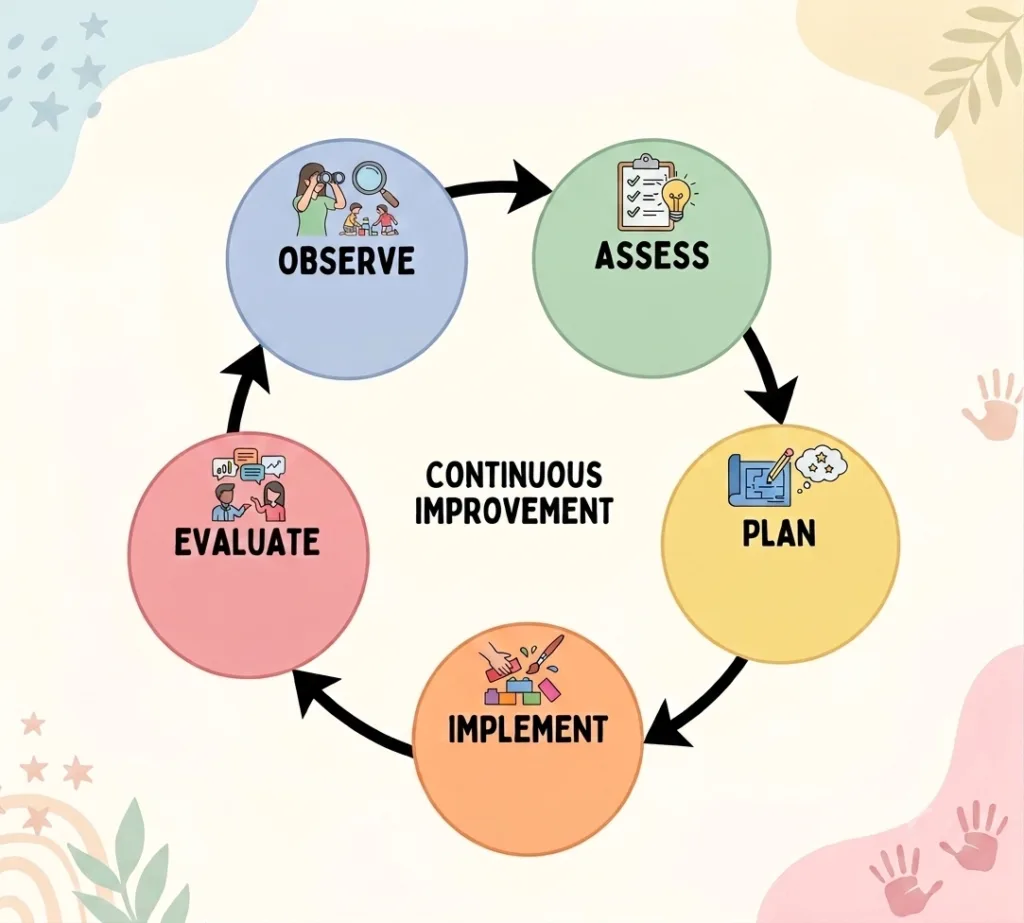
The EYLF Planning Cycle is a continuous process educators use to understand and extend children’s learning. It consists of five connected stages:
Observe → Assess → Plan → Implement → Evaluate → (back to Observe)
The cycle doesn’t stop. Once educators evaluate what happened, they observe again, and the whole process continues because children’s learning is always changing.
For example: A child becomes interested in collecting leaves. An educator notices this and observes why. Are they interested in textures, colours, or shapes? The educator plans activities around this interest, such as sorting leaves, creating nature art, and exploring tree books. After implementing these experiences, the educator reflects on what learning happened and uses that to plan the next set of activities.
By the time your child moves on from leaves, they’ve had experiences developing observation skills, vocabulary, classification abilities, and curiosity about nature. All of this emerged from genuine interest.
This is radically different from a childcare centre that runs the same program regardless of children’s actual interests or abilities.
The Five Stages of the EYLF Planning Cycle
Stage 1: Observe
Observation is where everything begins. Before educators can plan meaningful experiences, they need to understand what genuinely interests your child and how they learn.
Good observation looks beyond what children do to understand why they do it. An educator notices:
- What captures your child’s attention
- How they approach challenges
- How they communicate with others
- What questions they ask
- What skills are emerging
- How they learn best (alone or with peers, quickly or thoughtfully, through building or through conversation)
Observation happens throughout the day. This includes play, mealtimes, transitions, group time, and outdoor exploration. An educator notices that one child always chooses puzzles, another gravitates toward water, another wants collaboration, and another prefers solo activities.
Real example: A group of children collecting sticks and leaves to build a shelter. An educator doesn’t see “kids playing.” She observes children comparing stick sizes, testing different structures, solving problems when something falls, communicating ideas with peers, and adjusting designs. These observations become the foundation for future planning.
What matters: When educators take notes or photos during play, they’re not interrupting learning. They’re gathering information that makes future learning responsive to your child’s specific interests and abilities.
Stage 2: Assess
After gathering observations, educators step back and think about what those observations reveal about a child’s learning.
This is nothing like school tests or report cards. There’s no grading or comparing children against each other. Instead, educators ask:
- What is this child learning?
- What skills are developing?
- What interests could be extended?
- How does this connect to the EYLF outcomes?
- What support might help?
Real example: Following the stick-building observation, the educator assesses the children’s development. They are developing problem-solving skills (testing ideas and changing designs), communication skills (explaining thinking and negotiating), collaboration (working toward shared goals), and mathematical thinking (comparing sizes and exploring balance).
The educator now understands this activity provides rich opportunities across multiple areas of development.
Assessment also means talking with families. You know your child in ways educators don’t. Information about interests at home, family culture, important events, and language helps educators understand the whole child.
Stage 3: Plan
Now that educators understand what interests your child and what’s emerging, they plan experiences to build on that foundation.
Good planning isn’t asking “What activity will keep them busy?” It’s asking “What experiences will extend this child’s learning in a meaningful way?”
Planning considers:
- Individual children’s interests (not generic activities)
- What each child is ready for next
- How to support different learning styles
- What resources encourage exploration
- How to remain flexible if interests shift
Real example: Based on the construction interest, the educator plans several activities:
- Introducing recycled materials such as cardboard, fabric, and wood
- Reading books about different homes and habitats
- Adding measuring tools during building
- Setting up dramatic play scenarios using the built structures
Each activity builds on the child’s genuine interest while supporting different areas of development.
What parents miss: An activity looks simple from the outside. The planning behind it requires understanding what your child needs and how to challenge them appropriately. This planning process is often invisible to parents.
Stage 4: Implement
This is where planning becomes action. Educators introduce experiences while staying responsive to what actually happens with children.
Implementation isn’t following a rigid script. It’s creating conditions for learning and adjusting when children develop new interests or take activities in unexpected directions. An educator might have planned one thing, but if a child’s genuine curiosity pulls in a different direction, a good educator recognises the learning opportunity in that shift.
During implementation, educators actively support learning by asking open-ended questions like “What could we try instead?” and “What do you notice?” They introduce vocabulary, provide materials, and guide thinking without directing every moment.
Real example: During construction, a child suggests using larger branches to make the roof stronger. Rather than confirming immediately, the educator says “Let’s test it and see what happens.” Children experiment, test different materials, and discuss which works best. Learning becomes collaborative, hands-on, and driven by their own thinking.
Learning happens in structured activities as well as throughout the day. This includes mealtimes, transitions, and outdoor play. Quality educators notice and guide learning in all these moments.
Stage 5: Evaluate
After implementing experiences, educators reflect on what happened and what comes next.
Evaluation means asking:
- Were children engaged?
- What did they actually learn?
- Which strategies worked?
- What would I do differently?
- Where should learning go from here?
Evaluation is about educators improving their own practice, not about judging children. Crucially, evaluation leads straight back to observation, beginning the cycle again.
Real example: After the construction week, the educator reflects on what happened. Children were highly engaged, collaborated effectively, solved problems independently, and showed persistence. They are clearly fascinated by structures. Next week might explore bridges, buildings, and different types of structures.
Documentation Throughout the Cycle
Documentation isn’t a separate step. It happens throughout, helping educators record learning, reflect on practice, and communicate with families.
Documentation might be simple, such as a quick note about something a child said, a photo during play, or a sample of artwork. It might be a “learning story” explaining what happened and what the educator noticed about the child’s learning.
Good documentation shows real moments and explains the learning behind them. When you get photos and notes from your child’s centre, they’re evidence that educators are closely observing and reflecting on your child’s learning.
Real EYLF Planning Cycle Example: Preschool Construction
Observe: A group of preschoolers spend days building shelters from blocks, sticks, and fabric. The educator notices children comparing materials, testing structures, negotiating, persisting through failures.
Assess: Children are developing problem-solving, communication, collaboration, and early engineering thinking. They’re applying previous learning to new designs.
Plan: The educator introduces design drawing before building, provides measuring tools, adds related books about different homes and buildings.
Implement: During construction, the educator asks questions: “How did you decide where to place that piece?” “What could make this stronger?” Children experiment, test, and learn through hands-on discovery.
Evaluate: Children remained engaged over multiple days, collaborated effectively, developed confidence in sharing ideas. Interest in structures is clearly strong. Future experiences could explore bridges, balance, simple engineering.
The cycle begins again with new observations.
How the EYLF Planning Cycle Benefits Children
When educators continuously observe, assess, plan, implement, and evaluate, children benefit in several important ways.
Confidence develops. Children experience success because learning is pitched at the right level for them, based on what they can already do.
Communication skills strengthen. Through conversations, questions, and storytelling, children are immersed in rich language.
Problem-solving abilities grow. Children learn to investigate, experiment, and think independently instead of waiting to be told answers.
Social skills develop. Through group activities and collaboration, children learn cooperation, negotiation, and empathy.
Independence emerges. When educators provide choices and guide rather than direct, children learn to make decisions and take pride in their own discoveries.
How Parents Can Recognise Quality EYLF Practice
Quality early learning has visible signs:
1. Educators know your child as an individual. They understand your child’s interests, personality, strengths, and learning preferences. They mention specific observations about your child’s progress and adapt experiences based on individual needs.
2. Learning experiences have purpose. While children play and explore freely, educators intentionally design experiences supporting development. An activity isn’t just for fun. It’s building specific skills or exploring important concepts.
3. Families are included. Educators value information from families. They share learning through photos and stories. They ask about interests at home and use family knowledge to inform planning.
Final Thoughts
The EYLF Planning Cycle shows that early childhood learning is far more than activities and play. When educators intentionally observe, understand, and support development, every conversation, exploration, and interaction becomes a learning opportunity.
This continuous cycle of observing, assessing, planning, implementing, and evaluating creates learning experiences that are meaningful, personalised, and connected to each child’s unique journey.
Your child isn’t simply playing. They’re exploring, questioning, building relationships, solving problems, and developing the foundations for lifelong learning. All of this is guided by educators who understand them, respond to them, and believe in their capabilities.
Understanding the EYLF Planning Cycle helps you recognise quality early education and appreciate what’s really happening behind the scenes.
Frequently Asked Questions
What are the five stages of the EYLF Planning Cycle?
Observe, Assess, Plan, Implement, and Evaluate. Educators repeat these stages continuously as children’s learning evolves.
How is the Planning Cycle different from a curriculum?
The Planning Cycle is not a curriculum. The EYLF provides the framework and goals. The Planning Cycle is the process educators use to design experiences based on those goals.
How does documentation support the Planning Cycle?
Documentation captures observations, learning moments, and progress. It helps educators reflect, plan future experiences, and share learning with families.
Why is observation so important?
Observation is the foundation. Without understanding what actually interests and engages your child, planning becomes guesswork. With good observation, every experience is responsive and meaningful.
How do I know if my child is learning through play?
Quality educators can explain why activities matter and what your child is learning. If educators can describe specific skills developing through play activities, your child is learning intentionally, not randomly.
What’s the difference between EYLF and the Planning Cycle?
The EYLF is the framework explaining what children should develop. The Planning Cycle is the process educators use to support that development. The EYLF sets direction. The Planning Cycle provides the pathway.