Discovery-Based Learning: Unleashing Your Child’s Inner Scientist in Early Childhood
Have you ever watched a toddler intently shaking a rattle to understand where the sound comes from, or a preschooler meticulously stacking blocks until they inevitably tumble? That deep-seated, natural drive to explore is the most powerful tool your child possesses. Our philosophy is centred on capturing this spark through a powerful educational approach: Discovery-Based Learning.
This method is the backbone of high-quality early childhood education, transforming the classroom from a place of passive instruction into a vibrant laboratory of exploration. It’s an approach where your child is not just a student, but an active researcher, thinker, and problem-solver.
What is Discovery-Based Learning?
Simply put, Discovery-Based Learning is a philosophy where children find solutions and new knowledge for themselves, rather than being told the answer. The educator’s role shifts from a primary source of information to a thoughtful facilitator who provides the resources, prompts, and rich environments necessary for this independent exploration.
This concept is fundamentally woven into play based learning. For young children, play is their work, and discovery is their reward.
- It’s Active: The child manipulates, touches, investigates, and tries things out.
- It’s Curiosity-Driven: It starts with a question, a puzzle, or a “What if…?” moment sparked by the child’s own interest.
- It’s Experiential: It draws heavily on the ideas of educational pioneers like Jean Piaget and John Dewey, who saw children as “little scientists” and believed that true learning comes from direct experience—or learning by doing.
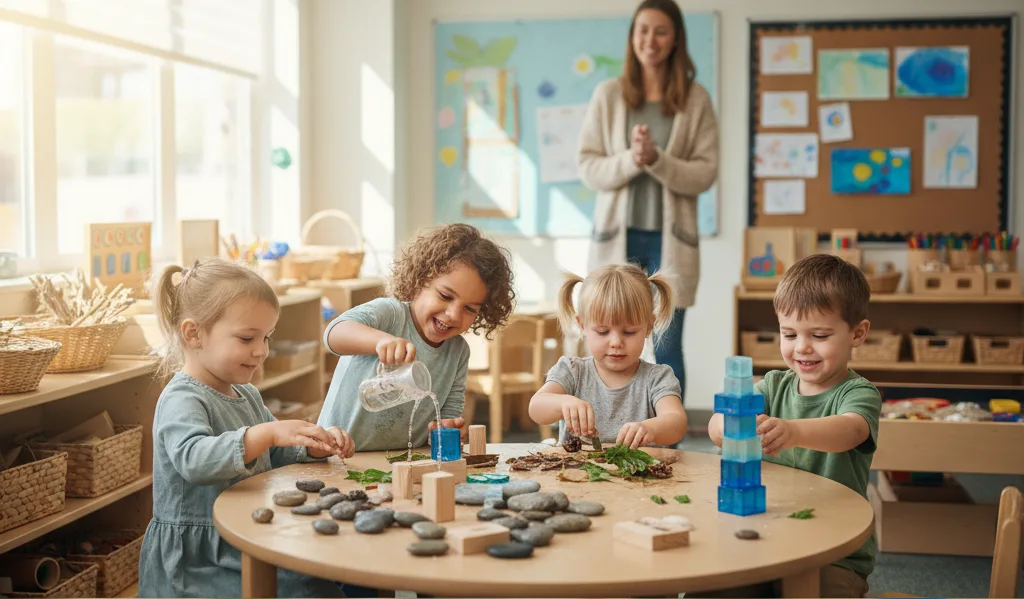
When a child is given a set of natural materials and asked, “What can you build with these?” they are engaged in the deepest form of discovery learning. They are experimenting, hypothesising, and finding solutions that are entirely their own.
The Power of Play: Building Confidence and Resilience
The benefits of discovery learning extend far beyond simply absorbing facts; they shape your child’s character and future capabilities. This approach is instrumental in nurturing child confidence by allowing children to experience the powerful satisfaction of self-directed achievement.
1. Fostering Critical Thinkers
When children are encouraged to discover the answers, they develop essential critical thinking skills. They don’t just know what happens; they understand why it happens.
For instance, if a block structure collapses, a child in a discovery-based environment doesn’t look for an adult to fix it; they instinctively analyse the error and try a different base. This process—trial, error, reflection, and adjustment—is the foundation of true problem-solving, a skill far more valuable than rote memorisation.
2. Deepening Retention
We know that children retain knowledge much longer when they discover it themselves. Instead of simply being told that certain colours mix to create a new one, a child who actively blends paints and sees the transformation firsthand forms a deeper, more personal connection to that knowledge. This ensures a much longer-term understanding, making the learning truly stick.
3. Cultivating Unshakeable Child Confidence
Perhaps the most significant benefit is the boost to self-esteem. Every small discovery, every puzzle solved, and every experiment completed successfully—or even unsuccessfully—is an affirmation of the child’s own competence. This sense of accomplishment builds resilience and teaches children that they are capable, resourceful, and in control of their own learning journey. This intrinsic motivation is the engine for lifelong learning.
Discovery in Action: Learning Through Play
At Learnig Blocks Dural, our environment is meticulously designed to facilitate discovery. This is where learning through play truly shines:
| Discovery Opportunity | What the Child is Discovering | Core Skill Development |
| The Mud Kitchen | What happens when you mix water, soil, and leaves? How does the consistency change? | Measurement, Sensory Exploration, Early Chemistry |
| Building with Loose Parts | How to balance objects, what shapes are strongest, how to follow a design plan. | Spatial Reasoning, Engineering, Collaboration |
| The Sensory Table | Sorting objects by size, texture, or weight; exploring cause and effect (e.g., water displacement). | Classification, Physics, Fine Motor Skills |
| Storytelling & Role Play | How different people feel, how to communicate needs, how to plan a sequence of events. | Empathy, Language Development, Abstract Thinking |
Our educators act as warm, engaged guides. We scaffold the learning by asking open-ended questions like: “How could you make that structure stronger?” or “What do you think will happen if you add more water?” We don’t solve the problem, we simply help the child ask the right question to discover the solution for themselves.
Fostering a Lifelong Love of Learning
Discovery-Based Learning is more than just a method; it’s a commitment to respecting your child’s innate curiosity. By embracing play based learning and encouraging children to lead their own explorations, we are equipping them with the resilience, problem-solving skills, and self-belief to thrive in an ever-changing world.
At Learnig Blocks Dural, we see every curious moment as a chance for a powerful, self-made lesson. We are here to nurture that curiosity and ensure it becomes the foundation of a bright future in their early childhood education journey and beyond.
Ready to see discovery-based learning in action?
Contact us today to schedule a tour of Learning Blocks Dural and discover how we can support your child’s natural curiosity and love of learning.